Ask any dealer what ruins a Monday morning and warranty paperwork comes up almost every time. It’s not just admin. A warranty claim is when a brand has the opportunity to prove that its promises truly stand behind the product. Handle it badly and you get frustrated customers, dealers who feel left to fend for themselves, and costs that creep up quietly in the background. Handle it well and, honestly, it becomes one of the better trust builders a brand has going for it.
Here’s the thing though. Most warranty operations are still built for an industry that moved a lot slower than this one does now. Paper job cards. Manual checks. Claims bouncing between two or three systems before anyone actually signs off. None of that fits a world where people track a food order down to the minute but wait two weeks to hear back on a warranty claim.
So what does warranty claim management actually cover, where does it usually fall apart, and what are OEMs doing differently in 2026 to fix it? That’s what this piece gets into.
What Is Automotive Warranty Claim Management?
Put simply, it’s everything that happens between a dealer raising a claim and that claim being approved and paid out. Logging the complaint. Checking it against the job card. Reviewing parts and labour. Getting sign off. Closing it out.
Each step is either building trust or burning it. A claim that moves through cleanly tells the customer their problem was actually taken seriously. One that gets stuck in email chains and follow up calls tells them something else entirely.
For a long time, this whole process has leaned on manual work. Dealers fill out the same form more than once, chase approvals for days, and generally lose time they don’t have. Technicians end up slower, customers end up annoyed, and costs show up that nobody budgeted for. Warranty claim management software exists precisely to close that gap, so service teams can spend their time fixing vehicles instead of fighting paperwork.
Why Warranty Claims Still Break Down
Better tools exist now. Most dealer networks are still stuck fighting the same problems anyway.
Paperwork that never seems to end
Job cards, invoices, claim forms. For a dealer group juggling several service centres, each with its own quirks and interpretations of the rules, this starts to feel like a second job. And once interpretations start drifting, errors follow, then disputes, then approvals that sit untouched for days. Digitising the process doesn’t just tidy things up. It stops the same data being typed in three times and lets claims close without the back and forth.
Fraud sitting right next to honest mistakes
Duplicate claims. Inflated labour hours. Repairs billed under warranty that were never actually covered. None of it looks dramatic on its own, but it adds up fast, usually without anyone noticing until someone finally reviews the numbers. McKinsey’s recent work on automotive quality points to something worth sitting with here: most OEMs are still managing this through retrospective, warranty led processes, even though there’s more vehicle and customer data available than ever before. Catching this stuff after the fact isn’t really catching it. Building analytics into the workflow itself, so odd patterns get flagged the moment they show up, is the actual fix.
Approvals that take forever
There’s nothing that tests a customer’s patience quite like “we’re waiting on warranty approval.” And when that approval depends on someone making a phone call, then waiting for a reply email, then following up again, delays aren’t a possibility. They’re the default. Letting dealers submit and track claims online, with real time status, cuts most of that out and, frankly, shows customers that their time actually matters.
Money quietly leaking out
Old, disconnected systems cost more than people realise. Data gets entered twice. Claims get rejected, then resubmitted. Reimbursements sit for weeks before anyone processes them. It all adds up, and it puts pressure on dealer margins and OEM warranty budgets alike. A connected system keeps parts and labour usage tied to policy, so the budget isn’t being drained by process failures dressed up as legitimate repairs.
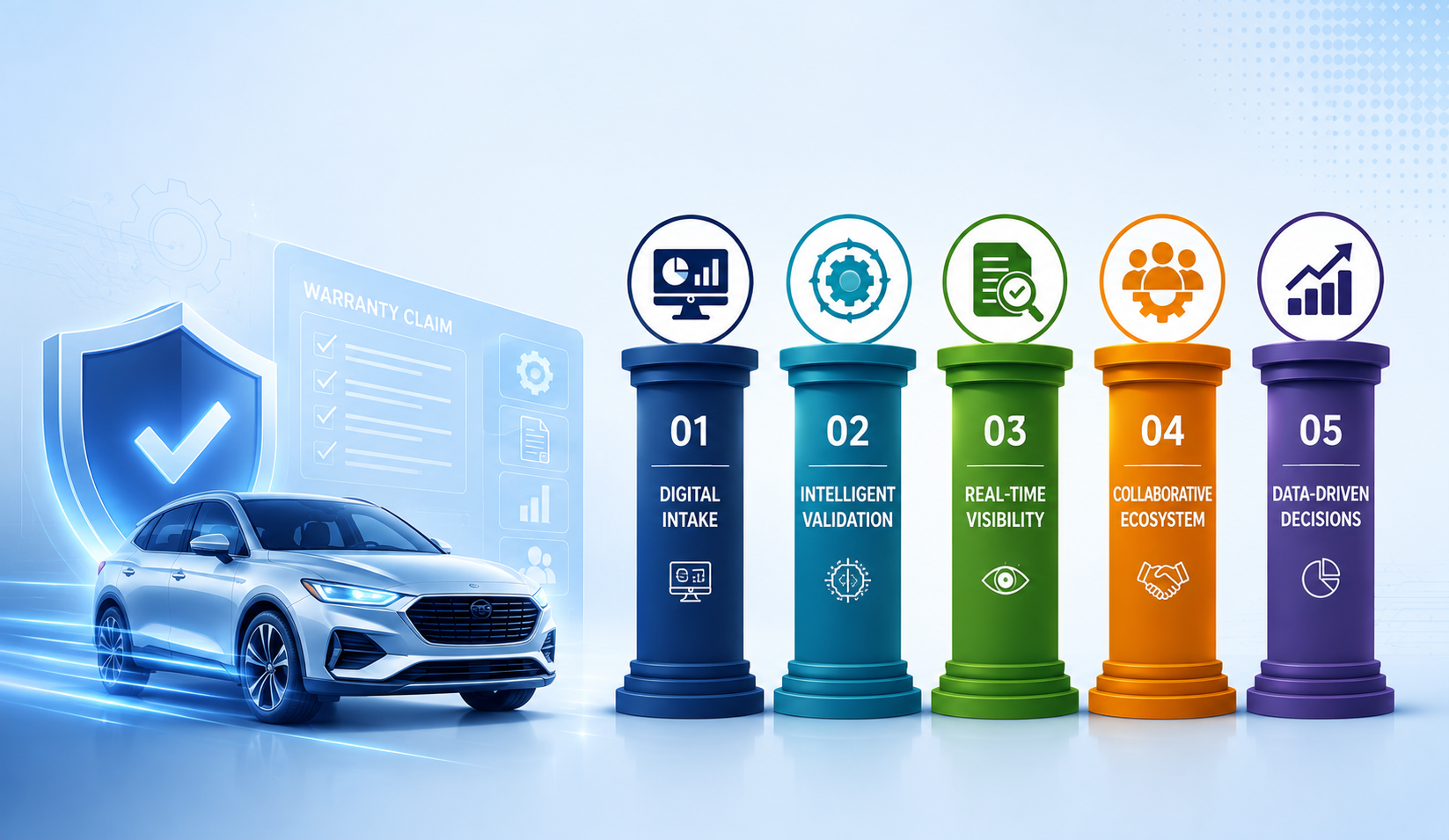
The 5 Pillars of Modernising Warranty Claim Management
Warranty operations are shifting fast, moving away from paper based approvals toward something automated, connected, and increasingly predictive. Here’s what that shift looks like broken into five parts.
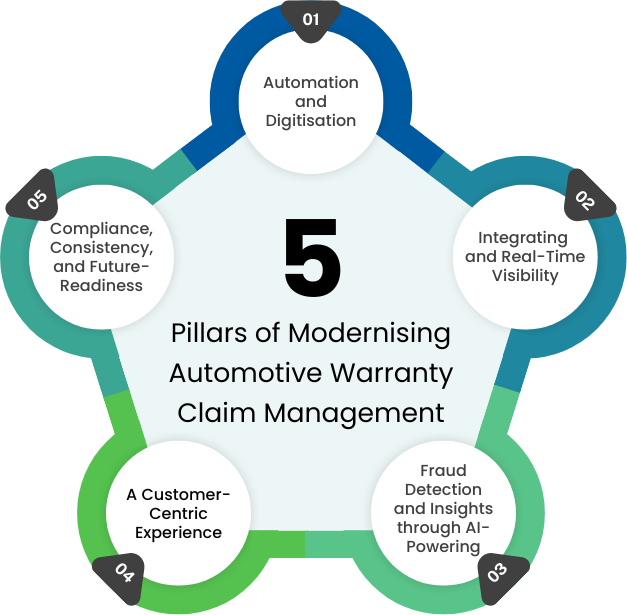
1. Automation and digitisation
Eligibility checks, document verification, sign off. These used to eat up hours but now they take seconds when system is set up right. Automating the repetitive stuff frees staff to deal with the exceptions that actually need a human, and with the customers standing in front of them.
2. Integration and real time visibility
Older warranty systems scatter data everywhere. Dealer databases in one place, OEM portals in another, telematics logs somewhere else entirely, and someone always ends up chasing three different teams just to get the full picture. Modern platforms pull all of it into one view. Service managers, dealers, OEM leadership, everyone sees coverage, repair history, and claim status without the runaround. Role based dashboards keep it relevant too. Nobody needs to wade through data that isn’t theirs to act on.
3. AI powered fraud detection and insights
Warranty fraud quietly drains a lot of money from this industry, and most of it goes unnoticed. AI and machine learning models now flag duplicate claims, inflated labour hours, and repairs that fall outside coverage terms, while predictive analytics can flag risk before it turns into an actual cost. McKinsey’s research backs this up too, noting that this kind of data only becomes useful when it cuts across functions and suppliers rather than sitting in silos, otherwise the models stay brittle and hard to trust. But fraud detection is really just the starting point. The same insights can surface patterns by model, region, or dealer, which turns warranty data into something OEMs can actually act on rather than just a number to track.
4. A customer experience worth the wait, or better yet, no wait at all
People expect the same visibility from a warranty claim that they get tracking a parcel. Real time updates. Proactive alerts. An easy way to ask a question without getting bounced between departments. And when customer feedback actually loops back into the process, people feel heard rather than processed, which is exactly what turns a one time buyer into someone who comes back.
5. Compliance, consistency, and staying ready for what’s next
Speed without compliance just trades one problem for another. Rules differ by region, and they need to stay consistent across every single dealer in the network, not just the ones paying closest attention. Modern platforms build compliance directly into the workflow, so audits get simpler and nobody’s operating off their own version of the rules. And with EVs, ADAS, and increasingly connected vehicles becoming standard rather than the exception, a warranty system built for 2026 has to flex around claim types that barely existed a few years back.
What to Look for in a Modern Warranty Claims System
Not every platform out there is built the same way. Here’s what’s actually worth checking before you commit to one.
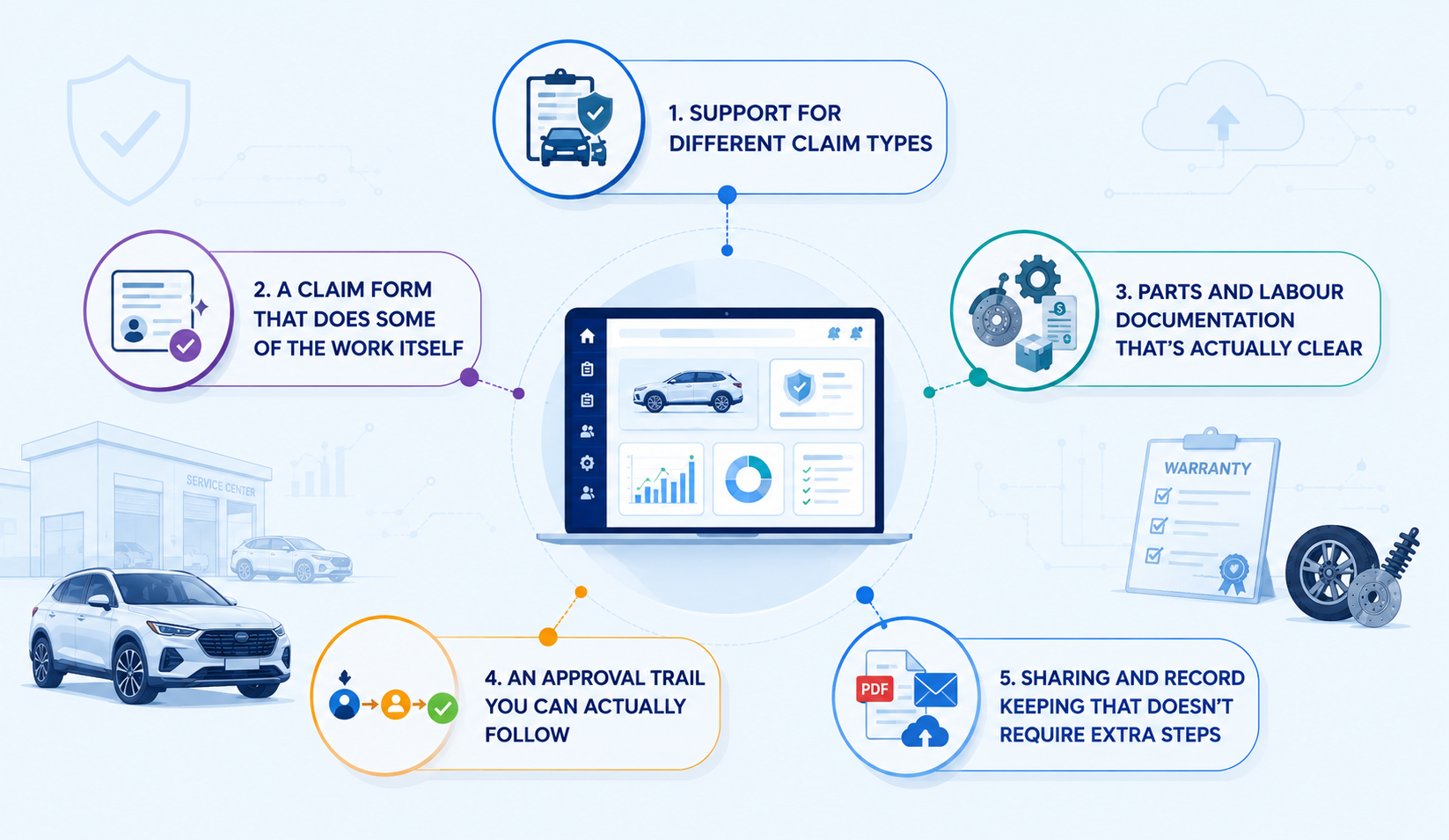
Support for different claim types
Not all warranty claims are the same, and a decent system treats them that way. Regular claims cover standard job cards and invoices. PDI claims let dealers flag issues found before a vehicle even reaches the customer, catching problems early rather than after delivery. Goodwill claims cover the smaller repairs done outside strict policy, the kind that build loyalty precisely because they weren’t required. A system that handles all three without forcing everything through one rigid form saves dealers a lot of grief.
A claim form that does some of the work itself
Retyping complaint details that already exist on the job card is a classic source of error. Forms that auto populate from existing service records, and that catch claims falling outside the standard submission window before anyone submits them, cut down on rejected claims considerably.
Parts and labour documentation that’s actually clear
Every claim needs itemised part numbers, quantities, and charges to count as complete. Systems built to make that fast to fill in and just as fast to review speed up approvals and cut down on disputes later.
An approval trail you can actually follow
Once a claim goes in, it should be obvious where it sits and who’s holding it up. A visible chain from submission to authorisation to payout keeps dealers in the loop and gives OEMs something they can actually audit.
Sharing and record keeping that doesn’t require extra steps
Being able to print or email a claim as a PDF sounds minor until you need it. It supports internal audits, keeps customers in the picture, and cuts down on the miscommunication that quietly wears away trust between a dealer and the people they serve.
Wrapping Up
Warranty claims don’t have to be the headache they’ve been for years. Done right, they’re one of the clearest ways an OEM can show customers and dealers alike that promises actually mean something. Stacks of paperwork, slow approvals, endless follow up calls. None of it holds up against how fast the rest of the industry moved in 2026.
With the right system, claims run through one connected process. Submissions happen without anyone chasing them. Fraud checks run quietly in the background. Every claim type follows its own path instead of being forced through the same one. What used to feel chaotic starts to feel, well, manageable. Sometimes even easy.
And the payoff isn’t just efficiency, though that’s part of it. It’s cost control, a dealer network that actually stays aligned, and customers who come back because they know they’ll be looked after.
FAQs
Start with a solid warranty claim management system. When dealers log everything online and can track progress as it happens, dealer, OEM, and customer all end up looking at the same information. Built in analytics help too, flagging anything unusual so claims get assessed fairly rather than on a case by case guess.
It automates a claim’s entire lifecycle, from submission through to reimbursement. Beyond speed, it cuts manual errors, keeps communication with the dealer network cleaner, and makes fraud or inefficiency far easier to spot before it turns into a real cost problem.
By centralising data, cutting repeat work, and getting rid of duplicate submissions. Fewer errors mean lower costs, and a dealer network that isn’t constantly fighting its own paperwork tends to just run better overall.
Yes, and a good one should. Regular claims, PDI claims, and goodwill claims all need slightly different handling, and a well built system supports each of them without cramming everything into the same form.
It does. Faster approvals, accurate documentation, and clear updates all tell the customer their time matters. Claims that get handled quickly and openly are one of the simplest ways to earn the kind of loyalty that brings someone back for their next vehicle.