The automotive industry is undergoing major transformation, driven by connected vehicles, rising customer expectations, and increasing cost pressure on OEMs. One area that has experienced dramatic inefficiencies for years—but is finally being modernized—is automotive warranty claim management.
For decades, warranty operations depended heavily on manual claim entry, subjective technician narratives, inconsistent dealership documentation, and delayed OEM approvals. The result was predictable: high processing costs, frequent claim disputes, slow reimbursements, and revenue leakage across the dealer network.
Today, as vehicles become more software-driven and OEMs push for tighter cost control, AI-powered warranty automation is emerging as a strategic differentiator. Instead of reactive, labor-intensive processes, OEMs can now operate with digital warranty management that is consistent, accurate, and fully data-driven.
This shift matters because warranty is no longer just about reimbursements— it is a powerful feedback loop that influences quality control, parts planning, service performance, customer satisfaction, and brand loyalty.
The Shift in Automotive Warranty Management
The warranty landscape has changed significantly:
- Vehicle complexity has increased, with electronics and software-related failures rising.
- Dealers handle higher volumes of warranty repairs compared to a decade ago.
- OEMs face rising warranty costs due to part failures, service errors, and fraudulent claims.
- Customers expect faster service, same-day decisions, and transparent communication.
- OEMs want clearer visibility into dealer repairs across regions and models.
Traditional warranty processing methods—paperwork, manual audits, spreadsheet tracking—cannot keep up.
This has led OEMs to adopt automotive warranty management software combined with AI and automation to handle the scale and complexity of modern operations.
Why Traditional Warranty Claims Slow Down OEM Performance and Why a Digital Strategy Is Now Essential
Traditional warranty processes remain one of the biggest bottlenecks for OEMs. Large portions of dealer networks still rely on outdated, manual, or semi-digital workflows, leading to delays, high error rates, and inconsistent submissions. Claims often depend on handwritten notes, subjective technician comments, and multiple approval layers, which slow down processing significantly. Without standardized formats or consistent documentation, OEMs struggle to enforce uniformity in claim coding, labor operations, and parts usage, resulting in frequent disputes, claim rejections, and cost overruns.
The lack of real-time visibility further complicates operations. OEMs cannot easily track repeat repairs, identify failure patterns across models, or detect dealers who overclaim. As a result, warranty expenses become one of the largest aftersales cost centers, with leakages and unnecessary payouts going unnoticed. Manual systems—paperwork, spreadsheets, and reactive audits—cannot keep up with the volume, speed, and complexity of today’s automotive networks.
This makes a digital warranty management strategy essential. As warranty costs rise across automotive, agri-equipment, construction machinery, and commercial vehicle segments, OEMs can no longer afford manual-heavy operations. A digital-first approach allows OEMs to enforce policy consistency, eliminate subjective interpretation, and centralize decision-making. It helps OEMs move away from disconnected spreadsheets and slow manual review cycles, enabling real-time visibility across dealers and faster, more accurate adjudication.
With a unified digital warranty system, OEMs can predict part failures earlier, manage risks proactively, and build a data-driven environment that supports both cost control and service quality improvement. AI strengthens this foundation even further, transforming warranty workflows from reactive to predictive and ensuring accuracy at scale. Today, AI-driven digital warranty management is no longer optional—it is a core requirement for OEMs that want to operate with speed, transparency, and efficiency.
How AI Transforms Warranty Claims: Speed, Accuracy & Cost
AI brings structure and intelligence to a process that has historically been reactive and manual.
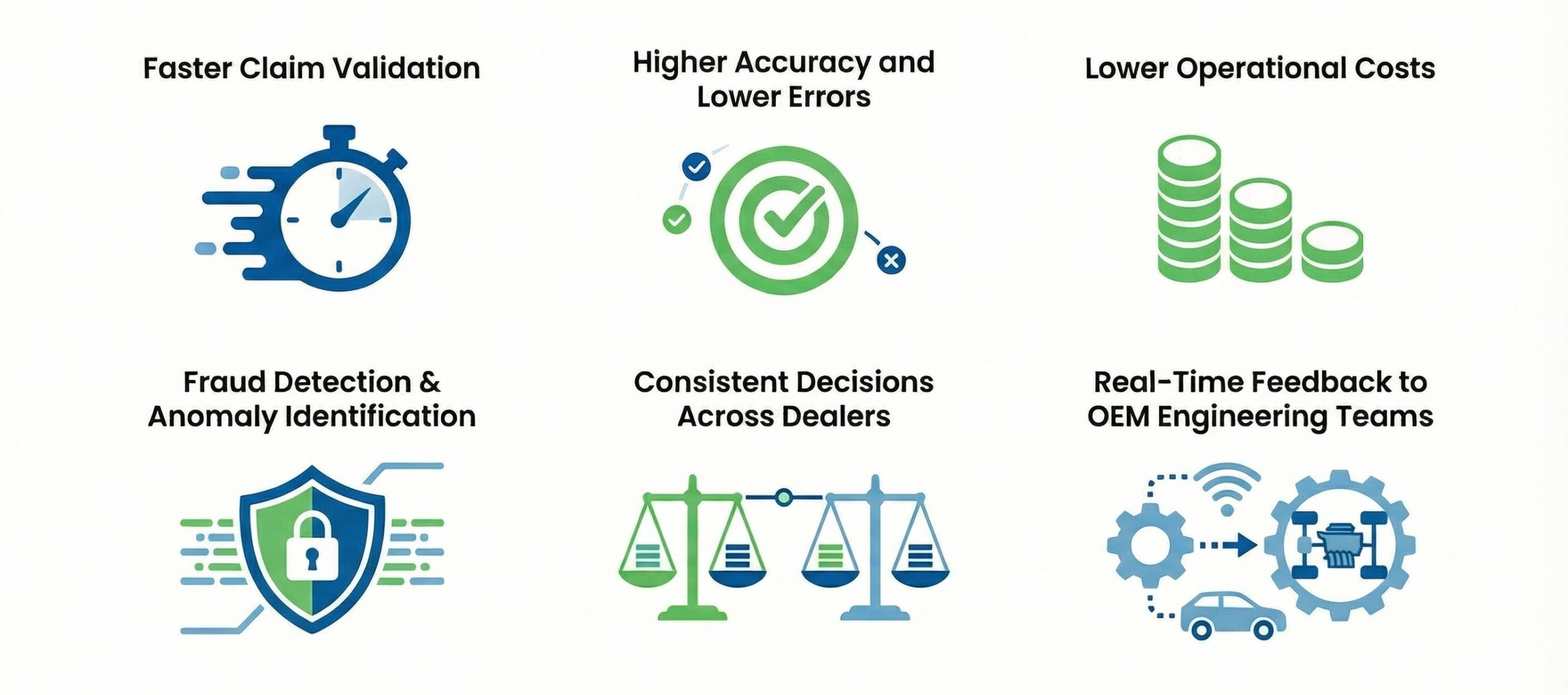
Here’s how AI upgrades the warranty workflow:
1. Faster Claim Validation
AI instantly checks:
- Required documents
- Technician comments
- Repair history
- Eligibility criteria
- Prior repairs on the same VIN
What took hours now takes seconds.
2. Higher Accuracy and Lower Errors
AI understands and standardizes unstructured notes using NLP. It ensures the dealer’s claim matches OEM guidelines exactly.
3. Lower Operational Costs
With AI reviewing most claims automatically, OEM teams only focus on:
- High-risk claims
- Exceptions
- Disputes
- Pattern analysis
This reduces the cost of claim handling by 30–50%, as per industry benchmarks.
4. Fraud Detection & Anomaly Identification
AI catches suspicious patterns such as:
- Repeated repairs on the same part
- Overuse of certain labor operations
- Claims submitted outside recommended mileage windows
- Inconsistent technician notes
This protects OEMs from major financial losses.
5. Consistent Decisions Across Dealers
No variation. No bias. AI ensures consistent adjudication across the entire network.
6. Real-Time Feedback to OEM Engineering Teams
AI clusters failure patterns by:
- Model
- Region
- Part number
- Usage conditions
Top 7 AI Use Cases in Modern Warranty Claim Management
AI transforms warranty operations through clear, high-impact applications across the dealer and OEM workflow.
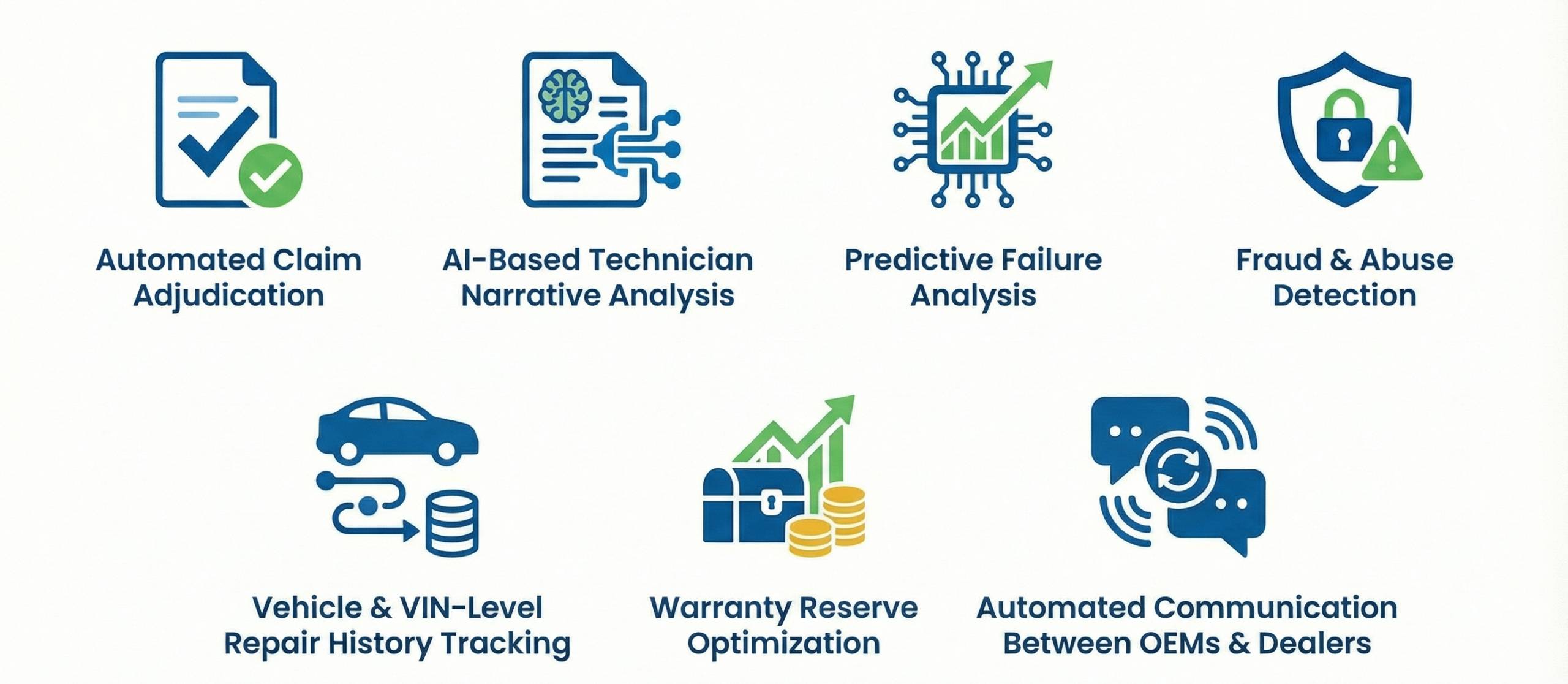
1. Automated Claim Adjudication
AI checks documentation, validates failure reason, and compares it to OEM policy. 40–70% of claims can be auto-approved depending on the program maturity.
2. AI-Based Technician Narrative Analysis
Technician notes are messy. AI interprets the text, extracts keywords, and confirms problem–cause–correction alignment.
3. Predictive Failure Analysis
AI forecasts:
- Which parts will fail
- Expected warranty load
- Regional spikes in failures
This helps OEMs control costs and plan parts inventory.
4. Fraud & Abuse Detection
AI identifies:
- Inflated labor hours
- Incorrect repair sequences
- Tampered mileage
- Unusual claim patterns
OEMs save money by stopping suspect claims early.
5. Vehicle & VIN-Level Repair History Tracking
AI connects repair events across the entire network, giving OEMs:
- True lifetime repair cost
- Repeat repair probability
- Part reliability insights
6. Warranty Reserve Optimization
AI helps OEMs use data—actual and predicted—to set more accurate reserve budgets.
7. Automated Communication Between OEMs & Dealers
AI bots streamline:
- Status updates
- Missing documentation alerts
- Policy clarifications
- Dealer interactions
This reduces back-and-forth communication significantly.
Benefits of AI for OEMs, Dealers & Customers
1. For OEMs
AI gives OEMs the visibility, accuracy, and control they’ve historically lacked in warranty operations. By automating claim validation and standardizing decision-making, OEMs can eliminate inconsistencies, reduce costs, and strengthen engineering insights. The result is a more predictable, efficient, and data-driven warranty ecosystem.
- Faster claim processing (up to 5×)
- Standardized decision-making across the network
- Reduced warranty leakage
- Better engineering insights through failure pattern mapping
- Lower operating costs
2. For Dealers
Dealers benefit from AI through smoother workflows, quicker reimbursements, and fewer claim-related disputes. With automated checks and real-time feedback, documentation becomes easier and claim accuracy improves, allowing service centers to operate with greater productivity and confidence.
- Faster reimbursements
- Fewer claim rejections
- Easier documentation
- Real-time claim status updates
- Higher service center productivity
3. For Customers
Customers experience faster service, clearer communication, and more transparent warranty decisions. With AI supporting dealers and OEMs behind the scenes, customers enjoy quicker repairs, fewer delays, and an overall higher level of trust in the brand.
- Quicker repairs
- More transparent warranty decisions
- Better service experience
- Higher trust in OEM brand
Why Businesses Choose NetFlows360 for AI-Driven Warranty Excellence
OEMs today need a platform that can handle high-volume warranty operations, enforce consistency across diverse dealer networks, and provide real-time intelligence that reduces cost and improves decision-making. NetFlows360 is designed specifically for these needs, combining AI, automation, and deep OEM–dealer ecosystem understanding to modernize the entire warranty lifecycle.
Built for High-Volume, High-Accuracy Warranty Processing
NetFlows360 helps OEMs streamline end-to-end warranty management by digitizing claims, standardizing submissions, and eliminating inconsistencies that arise from manual documentation. Claims move through automated workflows that validate data, flag missing information, and ensure faster, more accurate adjudication.
AI-Led Insights That Strengthen Warranty Decision-Making
The platform uses AI and machine learning to interpret technician narratives, detect anomalies, compare claims against OEM policies, and surface probable fraud or overclaim patterns. This helps OEM teams focus their efforts on exceptions and high-risk cases instead of manually reviewing every claim.
Real-Time Visibility Across Dealer Networks
NetFlows360 provides OEMs with a 360-degree view of warranty performance across regions, models, and dealer outlets. OEM teams can instantly track repeat repairs, part failure trends, labor patterns, and VIN-level service history—enabling smarter engineering, tighter cost control, and proactive quality improvement.
Faster Turnaround, Lower Leakage, and Higher Compliance
By automating documentation capture, policy checks, and claim routing, NetFlows360 reduces processing times and decreases human error. OEMs benefit from quicker reimbursements, fewer disputes, and stronger compliance with warranty guidelines. The platform’s predictive models also minimize leakage by identifying suspicious patterns early.
Designed for India’s Complex OEM–Dealer Ecosystem
Unlike generic global tools, NetFlows360 is built keeping Indian OEM environments in mind—high repair volumes, varying dealer maturity, inconsistent documentation, and diverse service conditions. Its AI models are trained on real OEM–dealer workflows, making insights more accurate and operationally relevant.
With NetFlows360, warranty management becomes faster, fairer, and fully data-driven—giving OEMs the speed, accuracy, and control needed to operate at world-class standards.
Wrapping Up
Warranty can no longer be viewed as a back-office function. It directly shapes customer experience, influences dealer performance, strengthens product quality, and ultimately defines brand trust. As automotive ecosystems become more complex and data-driven, AI is transforming warranty claim management into a faster, more precise, and far more efficient process. What was once manual and error-prone is now becoming automated, predictive, and optimized end to end.
OEMs that embrace AI-enabled digital warranty management gain a clear competitive advantage. They operate with better visibility across dealer networks, make faster and more consistent decisions, reduce unnecessary warranty spend, and build stronger alignment between engineering, service, and field teams. This shift not only improves operational outcomes but also elevates customer satisfaction by ensuring transparency, accuracy, and quicker resolution of warranty cases.
To fully unlock the benefits of this transformation, OEMs need a platform capable of supporting India’s scale, complexity, and diverse dealer environments. NetFlows360 provides that foundation—an integrated, intelligent system that modernizes warranty workflows, strengthens service operations, and connects the entire dealer network through real-time insights. With the right AI-powered DMS platform, OEMs can future-proof their warranty operations and create a stronger, more responsive ecosystem for the years ahead.
FAQs
AI eliminates manual errors, speeds up approvals, reduces warranty leakage, and gives OEMs real-time visibility into failure patterns and dealer performance.
AI detects fraud, improves validation accuracy, prevents overclaims, and identifies high-risk parts or repairs early reducing unnecessary payouts.
Yes. Dealers get faster reimbursements, fewer rejections, and more clarity on claim submissions.
Absolutely. AI helps manage high repair volumes, diverse dealer networks, and inconsistent documentation—common in India’s automotive and equipment segments.
NetFlows360 offers automated workflows, AI-driven insights, service management tools, and real-time dashboards designed to help OEMs streamline warranty claims end-to-end.