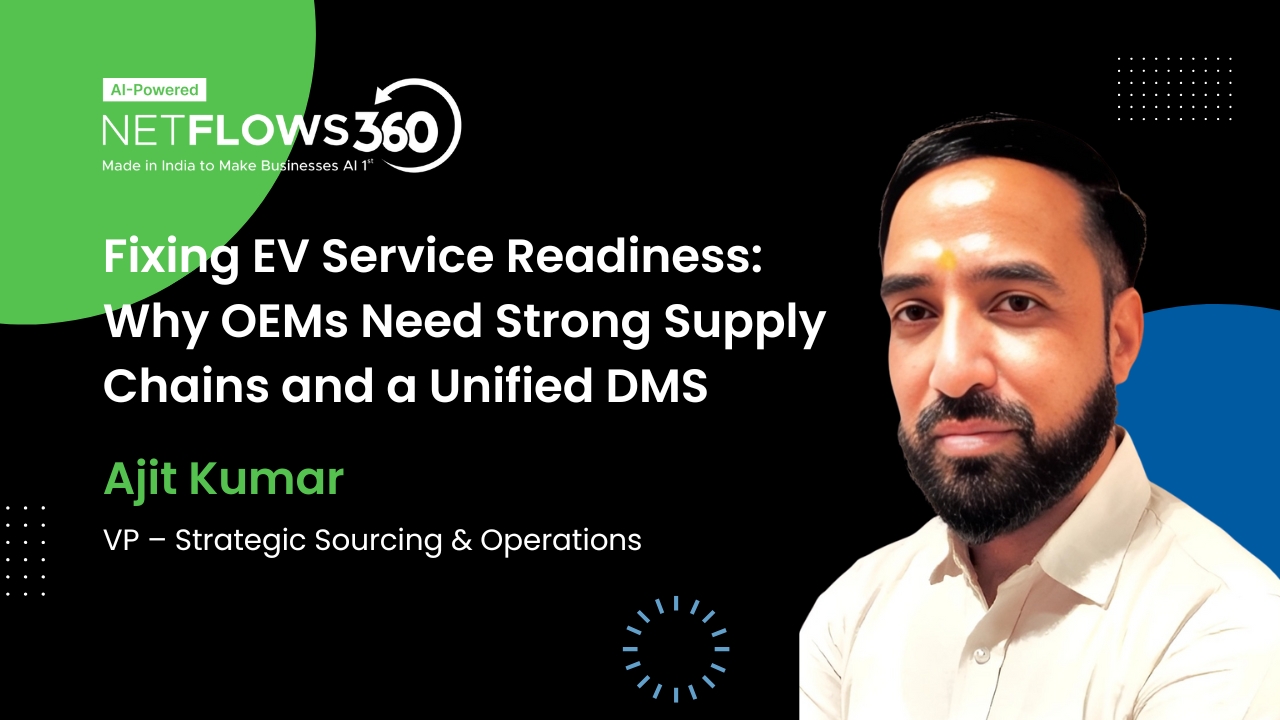
EV adoption is rapidly scaling, but service centers are still lagging. The really big challenges are not in making, but from the daily workshop activities.
Also, having the correct parts, competent experts, and seamless service processes will be critical in OEMs trying to establish lasting trust with their customers.
Recently, we sat down with Ajit Kumar, VP of Strategic Sourcing and Operations, for an interview to better understand what needs to change right now. Bringing experience from EV manufacturing and operations himself, Ajit shared some priceless tips on how to prepare dealers for success in the future.
Q1. From your experience setting up EV manufacturing and supplier networks, what gaps must OEMs address to ensure reliable after-sales and service readiness?
The service readiness gap is actually a transformation opportunity. First, supply chains are not fully synchronized for the EV world. Lead times for critical parts like batteries and electronics can stretch longer than customers can accept. Localizing supply and building strong partner networks can turn this into a strength.
Another gap is in systems. Dealers still have to cope with worn-out and disconnected systems that further delay diagnostics, service updates, and warranty-related decisions. A properly integrated DMS system will not only improve transparency but also smooth the workflows.
The third area is capability. EVs introduce high-voltage systems and software logic, and technicians need structured upskilling to handle them with confidence. Strong training builds trust on both sides of the counter — for dealers and customers.
Q2. Supply chain delays often become service delays. What structural changes should OEMs implement for strengthening EV service readiness?
We need to transition from reacting to planning. Real-time data from vehicles can help predict parts demand before a breakdown occurs. That needs to flow directly into supply chain planning.
Localisation is another key lever. If common service parts are nearby, customers don’t suffer downtime due to logistics. Well, when suppliers act as true partners, response time will get faster.
Shared visibility and teamwork across the ecosystem will not only help in eliminating bottlenecks but also improve the speed of the service.
– Ajit Kumar, VP – Strategic Sourcing & Operations
Q3. With EV demand rapidly increasing, how vital is a single DMS for complete visibility into service and parts operations?
It’s essential. A unified DMS provides the visibility and consistency that EV customers expect. It connects vehicle diagnostics, parts availability, service history, and dealer performance — all in one place.
When every entity is aligned on the same data, decisions become faster, inventory improves, and service turnaround becomes predictable. That builds confidence in EV ownership, and confidence accelerates adoption.
Q4. Many EV programs struggle with inconsistent dealer service capability. What steps can OEMs take to strengthen preparedness?
Three steps stand out. Firstly, standardised training and certification so every workshop can confidently diagnose and repair EV systems.
Secondly, advanced digital tools will enable the technicians to gain instant clarity on repairs. Thirdly, establishing consistent expectations across regions will ensure a predictable experience for every customer.
EV customers expect fast, reliable, and accurate service-and that can only happen when the whole network is consistent.
Q5. Which factor is going to make the most difference in EV service and lifecycle performance going forward?
Predictive maintenance is going to be the main enabler, hence allowing the vehicles to highlight issues before they strike and cause major downtime. Augmented support tools will also help in increasing speed and improving repairs. Local supply combined with global data and insights will further strengthen service networks. Therefore, success in the EV sector will solely depend on the collaboration of operations, data, and teams.
Wrapping Up
As Ajit Kumar reminds us, the difference between promised performance and real-world reliability is service. EV customers won’t tolerate long waits, uncertain diagnostics, or parts disruptions. The OEMs that unify systems, enable strong supplier alliances, and empower technicians with new skills will be the ones that scale confidently into the electric future.